Since music has been in existence since the beginning of time, are you aware that it can be a very effective tool in teaching as well? Regardless of whether your lesson involves basic letters of the alphabet for kindergarteners, complicated equations and formulas for algebra classes in high school, music in your lessons will help make the class interesting for the students.
As explored in our guide on why music is important, music plays a powerful role in cognitive development and emotional engagement. This article takes a look at the relationship between music and learning, the benefits it brings into a learning environment, how to select appropriate music, and how to effectively utilize music during class sessions – even virtual ones!
Why Music for Lessons Works: The Science Behind It

Before considering the “how” of integrating music into teaching, we need to examine the underlying “why.” There is a reason why the link between music and learning is so strongly supported by scientific evidence gathered over several decades.
Music does not simply give a sense of enjoyment when people listen to it. Listening to music engages multiple parts of the brain. This is why structured learning through music, as discussed in our article on the benefits of music, can significantly improve memory, focus, and comprehension skills.
A good example of the relationship between music and increased cognitive activity is known as the Mozart Effect. Although it refers to a relatively outdated experiment, published in the early 1990s, the effect still highlights the positive impact music can have on our brain functions.
Perhaps even more significantly, studies have discovered that musical rhythms aid the brain in processing and storing data. Data encoded with regularity or rhythm is simpler for the brain to recall or encode than unencoded data. That is why children can recollect nursery rhymes and the lyrics of songs prior to being capable of memorizing the multiplication table.
According to neuroscientist Nina Kraus from Northwestern University, musical training stimulates neural circuits responsible for reading and language comprehension, which are critical skills for academic achievement. Even just listening to music in a structured manner primes the brain for attentive and well-organized thought.
To sum up, music is not only pleasurable to learn but also physically transforms how the brain encodes and stores data.
Benefits of Using Music in the Classroom

Now that we understand the science, let us look at the specific, practical benefits that music brings into any learning environment.
1. Boosts Memory and Retention
Do you find yourself able to remember lyrics from a song that you heard many years back without having listened to that song since then? That is how powerful the combination of music and memory can be!
Learning via songs or in any other musical setting results in better memory retention compared to conventional methods of studying, where there is no music involved. This phenomenon is called the “music-memory connection.” Many studies have been conducted on students using this technique to test its effectiveness. Those students who learn material in the form of songs, chanting, or rhythmic repetition will remember the information much longer compared to students who simply read or repeat it.
There are many examples in which songs are used to help students learn. Songs can be used to teach the alphabet, multiplication tables, and names of the planets. This learning approach is commonly used in structured programs like children’s music classes, where rhythm and repetition enhance early education.
Use songs or poems to teach new ideas, particularly when teaching young children. Playing light music in the background while studying is useful for older learners.
2. Improves Focus and Concentration
Indeed, the current environment is filled with numerous distractions. One such distraction is smartphones. Besides, there is an increasing number of distracting factors in a modern classroom, including social media and other noises. Music, provided that it is used appropriately, can be a mental screen for all sorts of distractions.
There is a scientific consensus about the fact that instrumental music with a slow tempo, such as classical music, lo-fi beats, or ambient tracks, can help students get into a special state of consciousness known as flow state. In this case, the student becomes completely engrossed in the task they perform, becomes more productive, and works much quicker.
This conclusion has been confirmed by the results of a study conducted by the journal Psychology of Music. According to the study, students who listened to background music were able to complete their task faster and with fewer mistakes than those who worked in silence or had to deal with distracting noise around them.
Many structured programs, including adult music classes, use similar techniques to improve concentration and cognitive performance.
3. Reduces Stress and Anxiety in Students
It would not be an exaggeration to say that academic stress, test anxiety, and social stress are quite common among students at all educational levels. Fortunately, music can serve as one of the best methods for managing these emotions during class.
Research suggests that listening to soothing music causes cortisol levels. This aligns closely with findings in our article on dance for mental health, where creative arts play a key role in emotional well-being.
Many teachers believe that soothing music played while making the transition into the classroom, getting ready to leave, or moving from one activity to another helps to create a sense of calmness among the students and thus makes such periods much easier and stress-free.
Using music before important assessments also seems to be quite helpful since it allows students to relax and think more efficiently. You might want to create a playlist for “calming down.” It will come in handy in situations when you feel that you need a break from stressful periods like exams or transitions between classes. Music with a low tempo (about 60 BPM) works great for relaxation.
4. Encourages Creativity and Expression
Ultimately, music is an art form. Similar creative expression can also be seen in movement-based learning, such as dance classes, where students combine rhythm, emotion, and physical expression.
Fast-paced music may encourage innovative ideas among students during brainstorming, artwork creation, and creative writing activities. The music can help loosen up their minds to allow them to think differently from what is expected of them. Teachers have observed that their students generate more creative responses during creative activities when they listen to soft music in the background.
Not only does music allow students to be more creative, but it also provides a way for them to express their emotions. Allowing them to interact with music through activities such as selecting a playlist, analyzing songs, or even writing their own songs develops their communication and emotional intelligence skills. Allow students to participate in making class playlists for creative lessons.
How to Choose the Right Music for Lessons
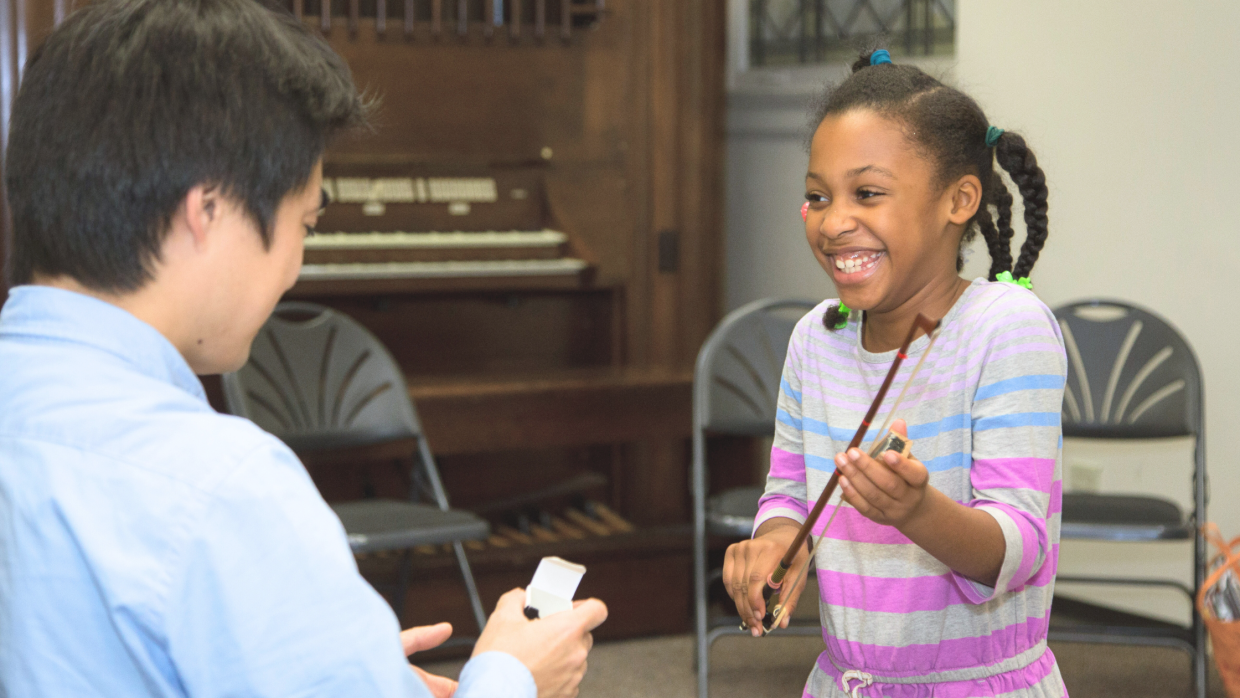
However, not all music has the same impact on learning. Sometimes, the wrong type of music may end up distracting students from concentrating on their work. Here are some tips that can be useful every time.
Ensure the music is appropriate for the task at hand. The first and most vital rule that should be considered is to ensure that the type of music matches the task being performed. Here is an outline:
- Independent reading or writing → Soft instrumental music or classical music without lyrics
- Creative tasks or art projects → Lively, upbeat music with medium energy levels
- Memorization or drill exercises → Music that is rhythmic, or relevant educational songs
- Transitions and movement → Fun, energetic music to signify a change in activity
- Relaxation or reflection → Slow, ambient music, or nature-based music
Think about age groups. Younger students, in the 4-10 range, usually benefit from simple melodies. These foundational learning methods are often introduced through programs like children’s dance classes, where rhythm and coordination are developed together.
Watch the tempo. Studies show that the optimal music tempo for concentration and learning should be between 60 and 70 beats per minute (BPM). Music with a slower rhythm creates a relaxed state that allows for better focus. Higher tempos, those above 120 BPM, are preferable for exercise and creative activities.
Choose the type of song wisely. When students read or write, their brain regions responsible for language processing are already activated. If the song that you choose contains lyrics that can be understood, your students’ brains will be forced to process two languages at once, resulting in worse performance.
Try, watch, and adapt. What works in one class may not necessarily work in another one. You need to see which musical genre works best with your students while working at their desks.
Practical Tips for Using Music for Lessons Effectively

Knowing the benefits of music is one thing; putting it into practice is another. Here are concrete, classroom-tested strategies to make music work seamlessly in your lessons.
Set Volume at the Right Level
This is one of the most crucial yet least thought-of variables for utilizing music properly. Music that is played too loudly distracts the listeners, while music that is too soft goes unnoticed. The optimum volume should thus be the background volume, wherein the music is heard by the listeners without having to deliberately pay attention to it.
Rule of thumb – If your students need to speak up to be able to hear each other when they are standing just the usual distance apart, the music is too loud for the classroom setting. Find the right balance where you can hear the music clearly and yet hold conversations comfortably. In bigger classrooms, instead of speakers positioned near the front, opt for a Bluetooth speaker placed near the center or the rear end of the classroom.
Use Music as a Transition Signal
The use of music as a behavior management tool within a classroom setting is one of the best things you could ever implement in your classroom. As opposed to yelling and trying to get students’ attention using other distracting means, let music do all the work for you.
Here are some instances where you could apply this concept:
Class entry signal: Whenever kids walk into the class each day, play a particular piece of music or playlist that lets them know class is about to begin.
Cleanup signal: Whenever you need your kids to clean up their things, use a particular piece of music to signal that time.
Focus signal: Whenever you want them to focus on work and study, use a particular piece of music for this as well.
End-of-class signal: Finally, use another piece of music to signal that it’s time for class to end.
This way, you will save lots of time, reduce the stress of reminding students of what to do through verbal commands, and create more structure in your classroom.
Create Themed Playlists for Specific Activities
Instead of picking songs on the spot, take a few moments before class starts to create separate playlists for different activities. This not only saves time but also makes things consistent and enables students to adapt easily.
Example playlists to consider creating:
- 🎵 “Focus Flow” – Instrumental lofi or classical for individual study time
- 🎵 “Creative Vibes” – Uplifting, cheerful tunes for creating and generating ideas
- 🎵 “Calm Down Corner” – Ambient music to soothe or calm down after intense activity
- 🎵 “Brain Break” – Upbeat, lively tunes for physical activities or dancing
- 🎵 “Morning Kickoff” – Lighthearted, optimistic music for morning greetings and energizing start
It is very convenient to create and store these playlists using popular services such as Spotify, YouTube Music, or Apple Music. Moreover, many teachers can find numerous educational playlists made specifically for classroom work on YouTube.
Music for Online Lessons and Virtual Classrooms
However, the evolution from traditional classrooms to virtual settings, even in digital environments, combining structured learning with creative disciplines like adult dance classes can enhance engagement and retention.
Make use of your platform’s features to play music. In most cases, any video conferencing tool, such as Zoom, Google Meet, or Microsoft Teams, gives an option to share computer sound simultaneously with the screen. Thus, you can play the background music via your device’s speakers and have it shared within the virtual classroom while you give your lecture. Make sure to use the “Share computer sound” feature while screen sharing.
Use music as transition cues in the virtual environment. Similar to physical environments, music in the virtual world can help to mark the beginning and end of various actions. Play your “focus music” while allowing your pupils to work independently in separate breakout rooms and switch to “transition music” when it is time to come back together.
Pay attention to the quality of audio that will be used in the virtual space. Bad audio quality could create additional distractions while listening to music. Thus, it is necessary to use decent microphones and sound systems and check the audio before the start of each lesson. Lowering the volume level is recommended since audio can differ among students’ headphones.
Support music autonomy. It is possible to share one’s playlist with the students and encourage them to listen to focus music on personal devices while working on tasks independently outside the classroom. Such an approach allows students to have control over their environment and teaches them how to work successfully.
Keep in mind copyright restrictions. The process of using music within online lessons requires taking into account copyright limitations. Therefore, it is better to use only royalty-free music websites, for example:
- Musicbed (licensed music without royalty)
- Free Music Archive
- YouTube Audio Library
- Pixabay Music
These websites provide an abundance of good music tracks that can be used freely without any worry about copyrights when using in virtual classes.